Friday, December 21, 2012

Rabbi Asch on Vayigash

In this week’s Torah portion, Vayigash, we read of a confrontation between the disguised Joseph and his brothers. Joseph demands his brothers leave Benjamin, Jacob’s youngest son, in Egypt. However, Judah steps forward and refuses to leave Benjamin behind. He explains that if they return without him the consequences will be severe for their father, Jacob: “When he (Jacob) sees that the boy (Benjamin) is gone, he will die, and [we] will have brought down our father…to the grave (Genesis 44:31).” Our text imagines the heart wrenching tragedy of losing a son. 
These ancient words take on a more poignant meaning less than a week after the tragedy in Newtown. We can imagine the parents who lost their children feeling, like Jacob, as if they too will die.  
Jewish tradition provides us with a framework for dealing with devastating losses. We learn that our losses do not ever go away entirely, but they get easier with time. During shivah, the first seven days after a death, we refrain from most of the rituals of daily life. We don’t shave or wear makeup or jewelry. We refrain from working and entertainment (music, movies, television, board games, etc.) At the end of shivah, a family takes a walk around the block, symbolically reentering the world. But mourning is not yet complete. During sheloshim, the first thirty days following a death, mourners continue to refrain from entertainment and celebrations. Between 30 days and one year after a death, an unveiling ceremony is held. The family visits the grave and the marker is officially unveiled. Psalms are recited and often remembrances of the deceased are offered. We may not all follow all of these rituals exactly, but it is helpful to acknowledge and mark our different stages of grief through changing our daily lives in some way.
Jewish tradition teaches us that we can, and should grieve intensely, but we cannot let our grief consume our lives forever. Psalm 30:12 reads, “You turned my mourning into dancing.” We know that the change from sorrow to joy cannot happen overnight, but through following Jewish mourning rituals we can honor our grief and our need to find joy in our lives as well.  

Tuesday, December 18, 2012

Candles for Newtown

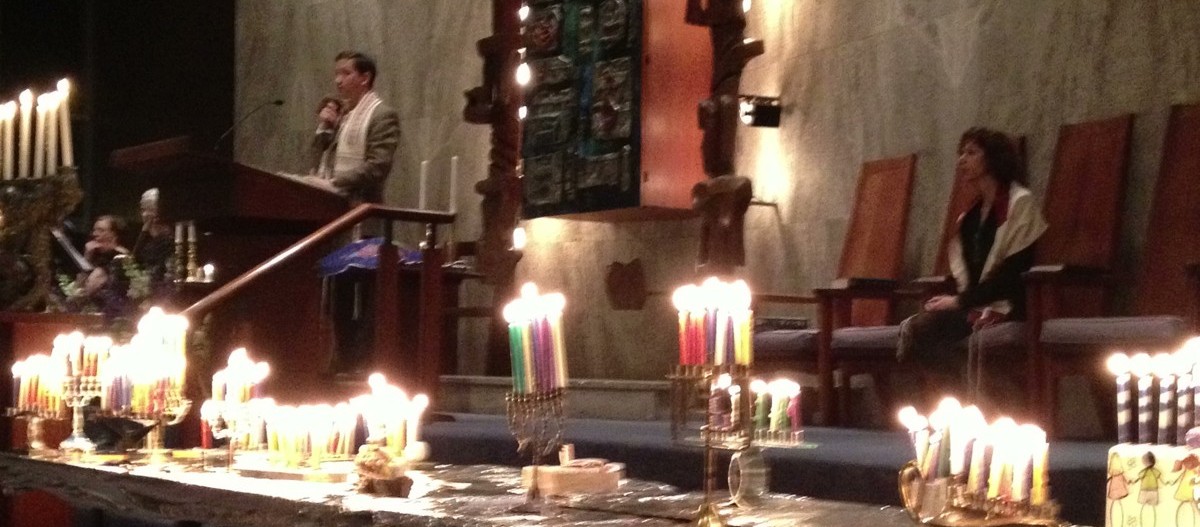
In memory of the victims of Newtown, Connecticut, Rabbi Roos opened with these remarks at last Friday night's services, which included Consecration of our first graders and our communal Hanukkah candle lighting. His sermon this week will directly address gun regulation and what we can do.

There is great joy and pride in this room tonight. It is Shabbat. It is the seventh night of Hanukkah. We celebrate as two students become b’nai mitzvah, leaders in our community, and we consecrate the newest class of Torah students, our first-graders. This will be a service and a night worthy of such great celebration. But outside these walls there is a darkness so heavy that no amount of candles can dispel it. Newtown, its victims and their families is too much to bear and we carry them with us in our hearts and into this sacred space. It is impossible and it would be wrong not to. So as we light the menorah, let us understand that these candles we kindle tonight are symbols but they are not a solution. They symbolize a great truth that is at the heart of the Hanukkah miracle: these candles do not light themselves, even if they last eight days once lit. Light does not come into dark places without somebody striking a match and lighting the flames. So too the world does not become better without us doing something about it. The world does not heal itself and it does not fix itself. Hanerot Hallalu, If these lights publicize any miracle tonight it is that we should leave here redoubled in our commitment to heal the wounded and fix what’s broken.

We take a moment of silence in memory of Newtown’s victims and to reflect on our commitment to change what’s broken in this world.

Friday, December 14, 2012

Cantor Croen on Parshat Miketz

The Torah portion this week, Miketz (Genesis 41:1-44:17) tells of Joseph’s complicated reunion with his brothers after 13 years of slavery.   He had become deeply assimilated into the Egyptian culture in which he was living.  But yet inside, he still did feel Jewish and cared for his family.  One can only imagine how alone he must have felt during holidays and times of Jewish ritual.  He was completely separated from the Jewish community and his family.  Even though he held a position of authority on the Egyptian Court, I believe his heart must have felt torn. 
In the midst of this week of Chanukah celebration we have the opportunity to reach out to our family members, friends and community members with whom we may have lost touch. This is an opportunity to renew relationships and perhaps reopen doors of communication that inadvertently may have closed.  We can use this moment to reconnect and rededicate ourselves to strengthening our community.  Holiday celebrations are hopefully times of joy but there are those around us, like Joseph, that are disconnected from their family and friends, thus left out and alone.
In these last three days of Chanukah observance, enjoy the brilliance of light as our Chanukiyot (menorahs) become more radiant with each night.  Take advantage of the opportunity share that light with those around you.  Take the time to look beyond your immediate circle to invite others into your celebrations.  Join the temple community at our Chanukah Shabbat service tomorrow night at 6:30 PM.    MMC (Middle Matzah Conspiracy) when our temple band will add exuberance to our service and celebration.  Be here when we welcome our newest young members , our first graders, into the congregation with a ceremony of Consecration.    Join us on the last day of Chanukah, Sunday, December 16 at 3:30 Pm, when we welcome contemporary singer/songwriter Dan Nichols to our congregation.  He will be our guest artist when we host this year’s Annual Greater Washington Area Jewish Youth Choral Festival.  Dan will lead some 200 singers from 10 local congregations in a spirited concert of song and celebration. 
Happy Chanukah!

Thursday, December 13, 2012

100 Blessings A Day - The App

Perhaps you’ve been to a Shabbat morning service and heard me introduce the Nisim B’chol Yom blessings. I use it as an opportunity to introduce the prayerbook – the theme of each blessing is in the margin of the page, the transliteration is to left, the footnotes offer deeper meanings and source citations. I also teach the Jewish tradition that we should offer 100 blessings a day. That is not to say that we should have a religious checklist that we tick off by rote but that we should be so fortunate and have such a sense of gratitude and wonder that we are spontaneously moved to blessing 100 times. I then offer that we will give you a jump start by doing your first 15 together from the prayerbook as we join responsively on page....  (cue the Cantor)

I understand that it takes more than good fortune and a sense of gratitude to offer 100 blessings daily. Many people are not liturgically literate or do not feel adequately prepared in terms of spiritual creativity so that they can offer so many of their own blessings. The Central Conference of American Rabbis has come to our aid with this newly released app. As they describe it:
Carry this collection of daily blessings to help express your appreciation for experiences, encounters, and more. Complete with Hebrew, transliteration, translation, and audio files of each prayer being clearly read in Hebrew. This app contains both traditional and contemporary blessings.
I downloaded it from the iTunes app store for $1.99 and have browsed through the blessings. I’m offering a blessing from the app to start each day and I, too, aspire to hit 100/day. The recordings are helpful for those learning Hebrew. There are a few shortcomings. There are not 100 different blessings on the app and some basics are missing: hamotzi (the blessing over bread) and other blessings over food, the blessing for Torah study (la’asok b’divrei torah), the bed time shema, the traditional “modeh ani” gratitude blessing recited upon waking and none of the blessings from Nisim b’chol yom. That shouldn’t stop you from getting the app and it certainly shouldn’t stop you from cultivating the sense of wonder and offering blessings each day.

Link to download the app for Android or iPhone here: http://ccarnet.org/ccar-press/blessings-app/

Thursday, December 6, 2012

What is Hanukkah? By Rabbi Jessica Oleon

Hanukkah* is right around the corner and I had a great time with the Confirmation class this week trying to unpack the “real” story behind the holiday.  Is it the Talmud’s version, “Mai Hanukkah?/Why Dedication?”, which is the first time we find the story of a miraculous single cruse of oil that keeps the Temple’s menorah lit for 8 days, or the version found in the Books of Maccabees and corroborated by Josephus about a brave band of guerillas fighting for their religion and their lives against a tyrannical king?  Is Hanukkah a celebration of the victory of religious extremists over assimilationists or a remembrance of the enduring power of hope and faith against great odds?  Or maybe just (and this is no small thing) a chance to gather with the people we love and create light in the midst of darkness.  I wish you could have seen our 10th graders wrestle with these questions, and the story of Rabbi Hugo Gryn, who wrote about the hanukkiah his father made out of his margarine ration in a Nazi labor camp.  They were a sight to behold—another generation wrestling with our tradition and what it means to each of them to be a Jew.  And I’ll ascribe to their conclusion, at least for this year, that Hanukkah is all of these stories, all of these miracles.  And that’s part of what makes it worth celebrating year after year.
For Hanukkah fun (because I can’t resist the creativity), here are two more ways to think about lighting your lights this year:
And from the geniuses at the Haifa Technion:  http://www.youtube.com/watch?v=We-KRSy64r4
Enjoy and Chag Sameach!
 *Yes, I prefer one “h” and two “k”s in my Hanukkah.  But I also love curry sweet potato latkes that make my house smell like a South Asian take-out joint for weeks, so I accept that I might have minority tastes here.

From Julie

Our tour guide on last summer's Israel trip sent me a note during the recent Gaza conflict:

Shalom Rabbi Roos, Elizabeth and the Temple Sinai Nine,

I was delighted to find your message in my in-box today and to know that we're in your thoughts and prayers.  It has indeed been an extremely unpleasant eight days, even in Jerusalem, where life has continued as usual (with the exception of two rocket attacks that had everyone cursing and improvising protected spaces - my husband and I dove into our laundry room,
which has no windows).

As you may remember, both of our daughters are medics in a search and rescue unit in the Home Front Command.  Since they have been training for over two years to rescue people from collapsed buildings, naturally their units were moved into the areas targeted by rockets and put on alert.  Happily, they had very little to do.  Stav's team was rushed to an apartment building in Ashdod that took a direct hit, which as it turned out was in the parking lot adjacent to the building.  She had to race up nine floors, knock on the door of each apartment and make sure everyone was OK.  Luckily, no one was hurt,
but a few people were hysterical.  "What did you do?"  I asked her.  "We sit with them, give them a drink of water, calm them down and make sure someone stays with them."

Shaked had no action at all.  For the past few days her unit was stationed in an elementary school in Ofakim.  At night they slept on the kids' desks. During the day they tried to nap but kept being wakened by the school bell, which no one could figure out how to turn off.  She came home Tuesday night to get some clean underwear but not in the least big hungry.  The good citizens of Ofakim had been bringing over generous quantities of food to the school for the soldiers (she took a picture of the tables where it was all piled up - it truly was enough for an army!)

The reason why our girls and their units had so little to do was the phenomenal success of the Iron Dome missile interception system, employed for the first time during this operation (we like to call it 'steel yarmulke').  With an 85% success rate, very few rockets fired by Hamas were able to reach their targets in Israeli residential areas.  It has, in this short time, become a game changer.  Although the lives of the residents of Israel's south were severely disrupted, the fact that the casualties and
damage were so limited meant that the army didn't have to rush the ground forces in Gaza to stop the firing and that Hamas' power was fabulously emasculated.  This also means that the Israeli home front will no longer be vulnerable in the same measure to rockets fired by Hizbollah, Iran or any other hostile entity.

What's important for you to know is that the development of Iron Dome was accomplished, in part, thanks to a generous allocation of funds from President Barack Obama in the name of the American people.  As I see it, through this assistance each and every one of you has contributed to the strength of Israel and the Jewish people.

What else can you do?  Get President Obama to remain intensively engaged in the region.  The moderate Palestinians are backstage somewhere and they need to be brought forward, encouraged and strengthened.  In all probability, Prime Minister Netanyahu will be reelected this January.  The Americans must wield not only carrots, but sticks too, in order to jump start the peace process.  Some stones have been left unturned and Netanyahu's government has intentionally stalled any possible progress for four years.  Hopefully, he will now realize how important it is to present the Palestinians with an alternative to Hamas but he will need serious prodding.  Tell Obama not to let up on him.

Happy Thanksgiving to all of you.  May we go from strength to strength!

Julie 

Wednesday, November 21, 2012

Rabbi Asch on Standing With Israel

As I have been following the news from Israel this past week and a half, I have felt many emotions: sadness, anger, worry. It’s not surprising that Israel is in the forefront of our minds in times like these. When we see pictures on the front page of the paper and hear the news on our radios, we can’t help but follow the events as they unfold.  However, to me, part of standing with Israel is remembering that there is more to Israel than this latest conflict.
While it might not always be at the forefront of my mind, the Israel I picture isn’t the one I see on the front pages. For me, Israel is much, much more. I think of the “cheese ladies” in the local grocery store who took interest in me and my roommate, chatting with us about how we liked living in Israel and encouraging us to by the feta with 65% fat, which was much better than that with only 33% fat. I think of my landlord’s daughter, who came all the way across town to deliver a homemade cake my first Shabbat in the apartment because the family wanted to welcome me to Israel. I think of the quiet that crept over the Jerusalem streets as the sun set on Friday and how everyone, religious or not, would wish each other Shabbat shalom. I think of the man who gave my roommate a ride home from the furniture store and then insisted she and I come to Shabbat dinner since we were new to the city. I think of the delicious the apples and honey flavored Yoplait sold in the grocery stores for Rosh Hashanah and of spotting a sukkah on every little balcony and in every courtyard on Sukkot. These are what I think of when I think of Israel.
So, as we stand with Israel during this conflict, I encourage you to think of the Israel that isn’t in the news; the one that isn’t always at the forefront of our minds. There is a whole country there, all year long, that never makes headlines.